NPC, creature and monster editors
NPCs are templates with a race and a visual. Monsters add a tier, a theme and base stats. Both live in libraries you can search, filter and duplicate, so build one good template and clone it.
Three editors, one shared idea: a template is a definition, and everything that walks around your world is an instance of one. Understanding that split is the difference between a library you can maintain and forty near-duplicate entries you are afraid to delete.
Template, instance, and why it matters
A template holds identity (an ID, a display name, a subcategory, a description), a visual, and a block of numbers. When the simulation needs a villager or a wolf, it spawns an instance from a template and gives that instance its own live state: hunger, equipment, inventory, traits and spells.
Change the template and future instances inherit the change. Living instances keep the state they already had. That is the practical reason to fix a template early rather than patching individuals later.
The NPC editor
| Section | Fields | Notes |
|---|---|---|
| NPC library | Search, race filter, category list | Library grows fast; name things properly |
| Identity | ID, display name, subcategory | The ID is the stable key, the display name is cosmetic |
| Visual | Icon, base visual from the catalog, catalog search | Catalog is large; the search field is the fast path |
| Race assignment | Race | This is what applies attribute modifiers |
| Data | Detail fields per template | Filled per template, not per instance |
An NPC with no race has no attribute shape, which means it fights, works and ages with defaults. Assign the race first, then the visual - it is easy to spend twenty minutes on a look for a template that ends up needing a different race entirely.
The monster library
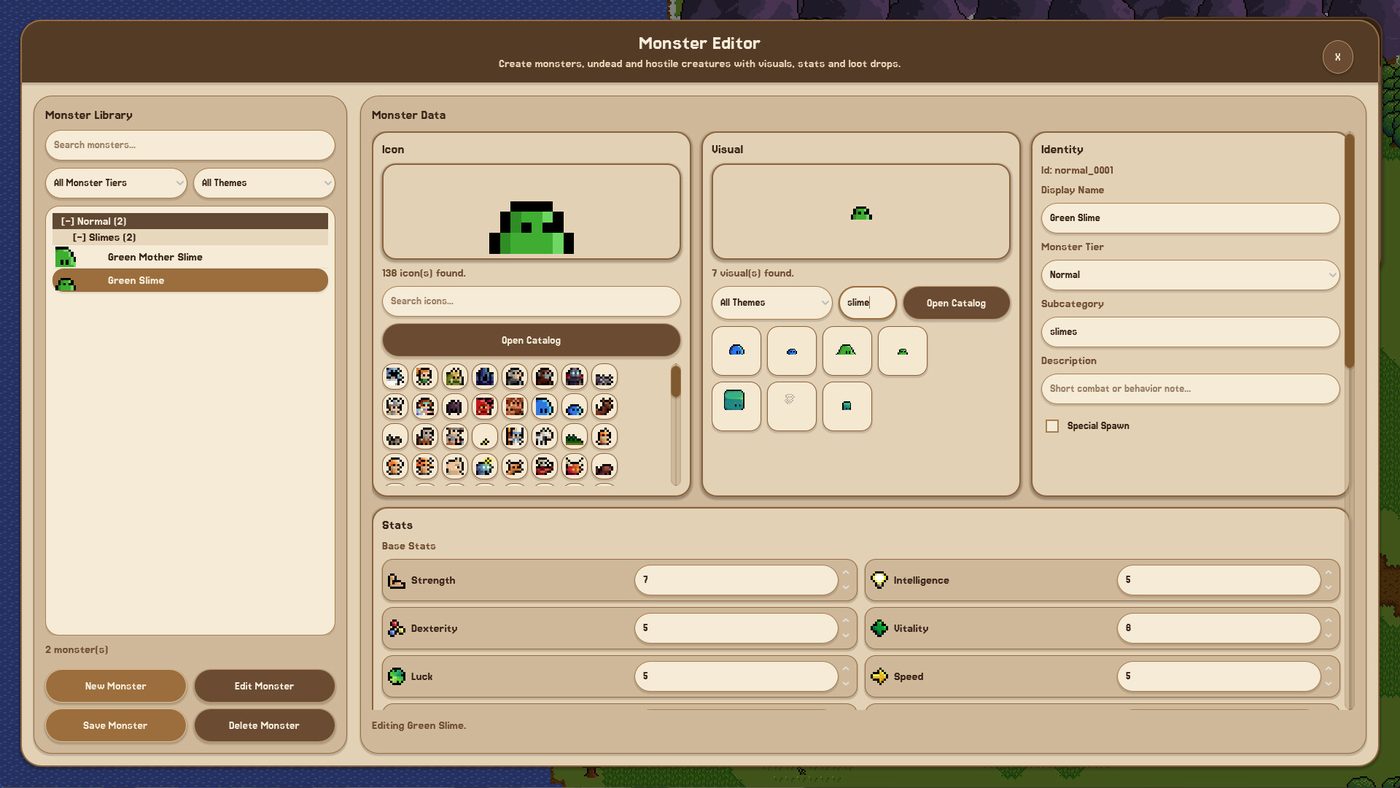
Monsters add three things an NPC does not have: a tier, a theme, and a base stat block.
| Field | What it does | Practical use |
|---|---|---|
| Monster tier | Groups monsters by power band | The library filter uses it; the game's own example content uses Normal for starter creatures |
| Theme | Groups by setting or family | Filter together with tier to find "the slimes I already made" |
| Subcategory | Free-text family label | Shows in the library count, e.g. a slimes group |
| Base stats | Strength, Intelligence, Dexterity, Vitality, Luck, Speed | The numbers the creature fights with |
| Special spawn | Spawn-specific flag | Use for creatures that should not appear through ordinary zone spawns |
| Description | Short behaviour note | For you, not the simulation - but it is the only place intent survives |
The library shows counts per group as you filter, which is the cheapest way to audit a bestiary: if one theme has thirty entries and the rest have two, your world has one kind of monster in it.
Where creatures come from
Monster instances enter the world through zone spawn rules, not through a global spawn table. That is the single most important mechanical fact in this page: a monster template that no zone references will never appear. If you build a beautiful troll and it never shows up, the zone spawn settings are the reason, not the template.
The reverse also holds. A zone with a healthy spawn table and a respawn timer will keep producing creatures from whatever templates it references, which is how a border zone becomes dangerous over time.
Equipment, inventory, traits and spells
All creatures carry equipment, inventory, trait and spell slots. For NPCs this mostly matters for soldiers and heroes; for monsters it is a way to make a specific creature memorable - a named wolf with a trait is a different encounter from the tenth anonymous wolf.
Because equipment modifies the same eight primary attributes as races, a template's effective strength is its base stats plus whatever it is wearing. Two monsters with identical base stats and different gear are not the same encounter.
Naming and library hygiene
The library stores an ID and a display name separately. Use the display name for what you will read in the editor, and keep the ID stable once content references it - renaming a display name is free, changing an ID is not.
A convention that survives a large project:
race_subcategory_###for NPCs, so the ID sorts by group.- One template per role, not per individual. "Guard, town" is a template; "Guard Bob" is an instance with a name.
- Delete test templates before you export anything. A prefab or a Workshop upload carries the library with it.
What these editors do not cover
There is no pet editor at launch - it is scheduled for the first 2027 update, alongside the quest and event editors. Class and spell authoring is scheduled for the third update, so creature spell slots are populated by what the build ships rather than by content you write.
The race and class guide covers the attribute side, the attribute reference lists every stat, and the editor reference shows which editors exist now and which are still coming.